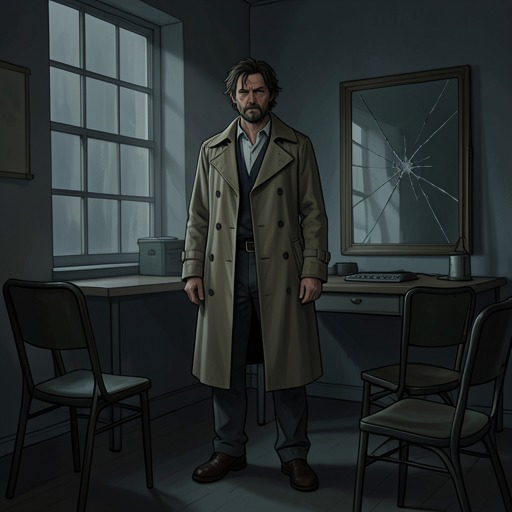
Alec Leamas
The Spy Who Came in from the ColdAlec Leamas is a British intelligence officer whose final operation turns professional deception against its practitioner: he is made to appear a disgraced defector, then discovers that the larger design is meant to shield Hans-Dieter Mundt and eliminate Jens Fiedler. The man who has spent his career managing concealed loyalties ends the novel confronting the truth of his own use, and dies at the Berlin Wall beside Liz Gold rather than escape alone.
Identity and Professional Background
Leamas’s work depends on keeping people, information, and loyalties compartmentalized. The narrative describes the secret agent’s deception as professional expertise, but also as a form of self-defence that must be maintained inwardly as well as outwardly. The agent cannot simply finish a performance and return to ordinary life: his role may prevent him from confiding in those closest to him or from behaving in ways that would reveal his actual position. Leamas embodies that isolation, and the novel’s account of it makes his eventual understanding of the operation more than a tactical discovery. He learns that the institution has also shaped and withheld the story he tells himself about his own actions.
His earlier Berlin work ends in apparent defeat. As he leaves Tempelhof, he regards himself as written off, a condition he expects to endure rather than overcome. He has no preparation capable of bridging the change from active field officer to discarded asset, and meets failure with resentment and solitary courage. The account compares his lost capacity to a dog whose teeth have been drawn, identifying Mundt as the person who has rendered him ineffective. The immediate operational result is stark: the service has Karl Riemeck, but Leamas leaves Berlin without an agent worth keeping, and Mundt has won.
The Staged Decline and Defection
Control later offers Leamas what he calls a last job, followed by the possibility of coming in from the cold. He also asks whether anything should be done for Liz, including financial help. The offer presents retirement as a possible end to Leamas’s isolation, but the operation that precedes it requires him to continue performing a role. When approached by the other side, Leamas calculates that his fresh prison experience, social resentment, and precarious circumstances make him a credible recruit. He understands why they would hurry to secure him and anticipates that they will expect practical objections and fear, not an appeal to injured honour.
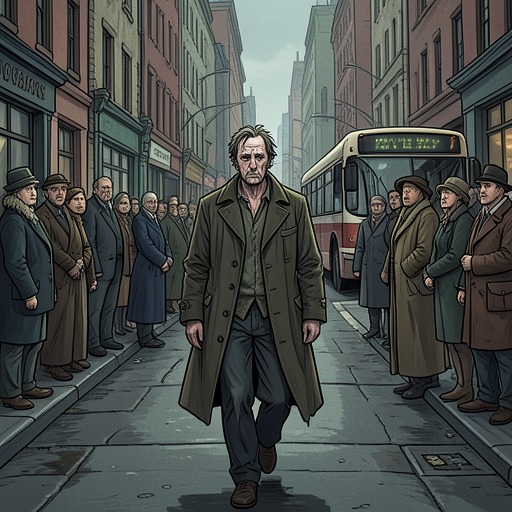
The appearance of decline is deliberately accelerated. Within a few months, Leamas changes from a man honourably put aside into a resentful, drunken wreck. He borrows small sums from secretaries and does not repay them, arrives late or leaves early on vague excuses, and develops a blunt, unreasonable malice. Colleagues initially treat the change indulgently, but his neglect and hostility eventually isolate him. These details establish the decline as a public performance built from recognisable lapses, while also showing its consequence within the Circus: the mask cuts him off from the people who might otherwise have understood or helped him.
His journey east is made to look both consequential and oddly easy. At the sector border, the cars wait for roughly ten minutes, apparently for a prearranged time; a DKW then passes the West German checkpoint first, and the Mercedes follows when the barrier is raised. In the subsequent interrogation, Leamas identifies Fiedler as deputy head of security, a man who conducts the major interrogations and serves Mundt. His account of the Berlin network includes information about its agents and personalities, but Fiedler judges it insufficient to justify the fifteen thousand pounds associated with Leamas’s apparent betrayal. It is accurate background, he says in effect, yet much of it is already known. The shortfall keeps the questioning open and focuses attention on what Leamas has not disclosed about Operation Rolling Stone.
Evidence, Suspicion, and Revelation
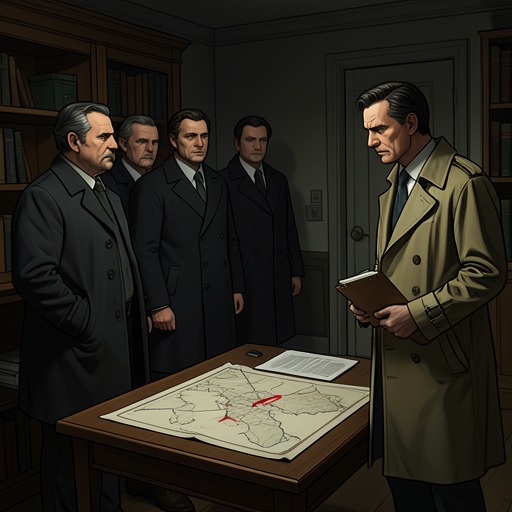
The interrogation turns on how evidence is interpreted. Peters presses Leamas on whether all the intelligence came from Riemeck, while Leamas later recognizes that both Peters and Control had insisted Riemeck must have had high-level help. Leamas knows Riemeck had minor helpers, including people connected with the canal, but sees that this does not explain the certainty shared by the two questioners. Peters, with precise knowledge of what Riemeck could access, had rejected the possibility that he acted alone; Control had asked about the same access. The convergence of their questions becomes a clue that Leamas can only understand retrospectively.
Fiedler likewise refuses to treat the material as a completed case. He argues that Leamas has offered only one intelligence item—the information about Riemeck, already known—and that the account of the Berlin organization amounts to old information, collateral, and minor leads. He returns instead to Rolling Stone and asks what Leamas would conclude if an apparent defector had offered him a comparable story. This challenge puts Leamas’s own professional habits at the centre of the inquiry: the issue is not simply whether his disclosures are true, but what pattern they imply and who benefits from that pattern.
A financial clue sharpens Fiedler’s case against Mundt. A Copenhagen bank reports that the money Leamas deposited was withdrawn by his co-signatory exactly a week later. That date coincides with a two-day Danish visit by Mundt, travelling under an alias to meet an American agent attending a world scientists’ conference. Fiedler’s question about whether Leamas should reassure the bank that everything is in order makes the transaction’s apparent irregularity part of the evidence rather than a resolved administrative detail. Later, while addressing the Tribunal, Fiedler again sets out the restricted circulation of the Rolling Stone file, the letters to the Copenhagen and Helsinki banks, and the single reply Leamas received. The file-handling details and bank correspondence are not incidental: they are the components from which Fiedler tries to infer the hidden relationship.
At the Tribunal, Leamas is brought to stand before the table with Fiedler only six feet away. The hearing’s scrutiny culminates in a sudden reversal: with the clarity of someone who has been deceived for too long, Leamas understands the operation’s design. He then states that Mundt is London’s agent, recruited while in England, and that the operation was arranged to save him from a clever Jewish colleague in his own department who had begun to suspect the truth. The accusation gives the scattered clues their new meaning. Leamas recognizes that the apparent defection and the testimony around Rolling Stone have been made to serve Mundt’s protection, and that Fiedler’s destruction is part of the price.
Relationships and Institutional Conflict
Leamas’s relationship with Control is shaped by command, incomplete knowledge, and calculated use. Control offers him a final assignment and the prospect of release from the profession, but the later revelation makes clear the gap between what Leamas was told and what his role served. Control’s earlier question about Riemeck’s access also returns as evidence: Leamas notices that Control and Peters had pressed the same assumption about a high-level collaborator. What first seemed like a narrow line of interrogation becomes a sign that the operation’s directing intelligence was not the account Leamas had been given.
Fiedler is at once Leamas’s interrogator and the person whose reasoning helps expose the operation. Leamas initially describes him as Mundt’s deputy and a formidable interrogator. Yet Fiedler’s scrutiny of the money, the bank letters, the file’s limited circulation, and the value of Leamas’s disclosures makes him an active investigator rather than merely an instrument of questioning. Their positions shift as Leamas comes to see that Fiedler’s suspicion of Mundt is well founded, even though the operation has placed them on opposing sides of an interrogation.
Mundt is Leamas’s adversary in Berlin and the beneficiary of the scheme that Leamas eventually identifies. Leamas’s own account of his earlier defeat assigns Mundt responsibility for disabling him and for the loss of the remaining useful agent network. The final disclosure deepens that conflict: the man who seemed to have beaten Leamas in the field is also London’s recruited agent, protected by an operation that uses Leamas’s apparent betrayal to remove the colleague who threatens to expose him.
Leamas’s bond with Liz Gold gives the final crossing its personal stakes. Control asks whether she should receive money or other assistance, a question that places her within the reach of the service’s decisions even before the escape attempt. At the Wall, Leamas holds her arm and guides her forward during a brief interval of darkness. After reaching the top, he reaches down and tries to pull her up; when she falls from his grasp, a voice from the Western side calls for him to jump. He hesitates rather than leave her, climbs back down, and stands beside her body. His choice does not undo the operation or save them, but it makes his last action a refusal to treat her as expendable in the way the institutions around them have treated people.
The Wall and the Ending
The Berlin Wall gives the novel’s final crisis its political setting and its physical limit. Leamas recalls that he flew from Bonn to see it as soon as construction began, accompanied by an Embassy colleague. The colleague noticed that Leamas seemed to be grinning, though Leamas says he felt disgust and terror. The Wall appears to him as both theatre and a symbol of ideology’s monstrosity. That remembered response supplies a frame for the last crossing: the boundary is at once a visible political spectacle and a lethal obstacle for individual people trying to pass through it.
The Wall’s construction had already transformed the conditions of intelligence work. At Königswinter, workmen painting Leamas’s dining room quietly washed their brushes and went home when news of the first barricades arrived; meanwhile, the Embassy discussed evacuation plans. At Checkpoint Charlie, American and Soviet Bloc tanks faced each other across a hundred-yard strip, their guns aimed at one another. The border also caught secret networks unprepared. Some agents became stay-behind operatives, dependent on hidden radios and prearranged secret writing, while espionage grew more clandestine, perilous, and crowded. Against that background, Leamas’s final attempt to cross is not an abstract gesture: it takes place in a divided city whose new boundary has reorganized both political life and the machinery of espionage.
At the Wall, Leamas uses a moment when the searchlight swings away to move with Liz. He feels for the rough brickwork, climbs using metal wedges driven into the wall, and discovers that the lower strand of wire has already been cut. As sirens sound and orders are shouted, he balances astride the top and draws Liz toward him inch by inch. Shots are fired; her arms slip from his hands. From the Western side, someone calls for him to jump. He looks down, sees that Liz is dead, and descends the same makeshift rungs to stand beside her. Only then do the guards fire again, and Leamas falls. His final view is of a small car crushed between large lorries, its children waving cheerfully through the window, an image that places ordinary, oblivious life beside the border’s violence without reconciling them.
Leamas’s ending completes the novel’s critique of an intelligence system that treats people as pieces in a larger operation. His apparent career collapse is engineered into a means of access; the intelligence he supplies is judged for its usefulness within a concealed design; and his eventual insight comes too late to prevent Fiedler’s intended removal or save Liz. At the last barrier, he faces a choice between his own possible escape and returning to her. He chooses the latter, and dies on the boundary that had first struck him as perfect political theatre. The Wall’s symbolism thus resolves in a concrete human consequence: the institutions and ideologies contesting the crossing leave Leamas and Liz dead between East and West.